This is the second blog post in the Google Summer of Code 2026 series and serves as the midterm report. View the previous blog post here.
Over the last few months since its v1.0 release, Dapr Agents has grown significantly thanks to the work of its maintainers and many contributors. While its core capabilities — durable execution, orchestration, and tool calling — have solidified, there is still plenty of work ahead to help increase the adoption of scalable, secure, and long-running agentic systems in new and existing architectures alike. This post provides an overview of some of the recent (and upcoming) features in Dapr Agents, and how they fit into the bigger picture.
Making Dapr Agents more flexible and extensible
One factor that helps drive adoption of a framework is flexibility. Each organization has its own very specific use cases along with processes and regulations that it must follow, teams have different responsibilities, and developers have individual skillsets and preferences. However, frameworks need to abstract certain details and be opinionated to some degree to be worth considering in the first place (for example, Dapr Agents’ core capabilities can be considered “opinionated”). To capture the widest audience, a framework needs to straddle the fence between being flexible and being opinionated.
In Dapr Agents, flexibility for agents was previously limited to “core” agent components: LLM providers, memory backends, and tools. With recent and upcoming features, this flexibility now extends to virtually the entire agent lifecycle:
- Callbacks (activations) to allow arbitrary sources to trigger agent executions, including publish/subscribe messages and webhooks
- Hooks to allow for policies and human-in-the-loop intervention at key stages during agent execution, mainly for LLM and tool calls
- Plugins (in-progress) to augment agents with custom state and the ability to run complex logic at key stages during agent execution (think of this as an even more flexible version of hooks)
- Extensions (in-progress) to provide officially-maintained callbacks, hooks, and plugins through developer-friendly interfaces for common use cases
An ecosystem of robust, pre-built extensions greatly simplifies agentic systems development, especially as agents are entrusted with more complex tasks, are deployed at scale, and become long-running, autonomous systems.
If there is an extension that you would like to see or contribute, feel free to raise an issue in the Dapr Agents repository.
Drasi extension for Dapr Agents
Dapr Agents’ first officially-maintained extension aims to simplify the integration of Dapr Agents into event-driven microservice architectures. Event-driven communication is a core principle of Dapr Agents, making it naturally suited for agentic workloads that need to react to events produced by external systems.
In some cases, events can be readily consumed from existing internal services or third-party providers such as GitHub, Jira, or Slack. For example, you could have a triage/SRE agent that validates incoming tickets and assigns severity levels based on their content:
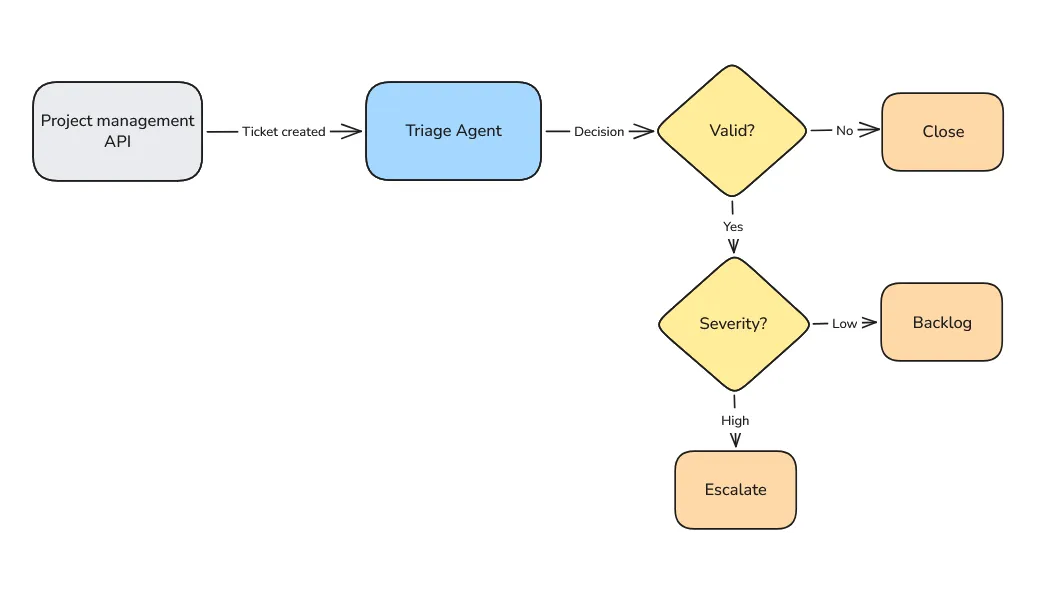
This works well if the event types are supported, however, in certain situations you might want agents to be triggered by specific domain events with the exact context needed to take action — instead of a generic “order created” event, these events could be “a customer’s order was placed but has been stuck in ‘shipping’ for a week due to delays, decide who needs to be notified and what needs to be done with the customer, order, transaction, and seller details”:
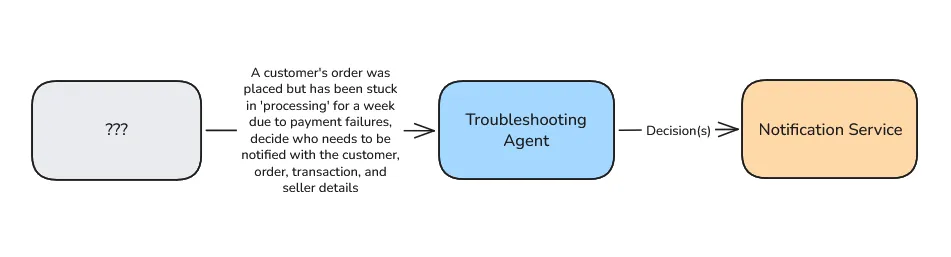
These kinds of events are complex: they may involve multiple domains, have a temporal dimension, or depend on previous events — needs that are unlikely to be supported by any individual service or third-party provider. Building custom pipelines that track raw data changes scattered across source systems — databases, streaming platforms, providers, and more — and packaging them into high-level business events agents can actually consume is a hard problem; it requires a significant amount of development labor and distributed systems expertise, and maintaining that infrastructure can be operationally complex.
Drasi, a CNCF Sandbox project, aims to fill this change detection gap: it can track changes from a variety of sources and emit a high-level business event only when a user-defined condition is satisfied.
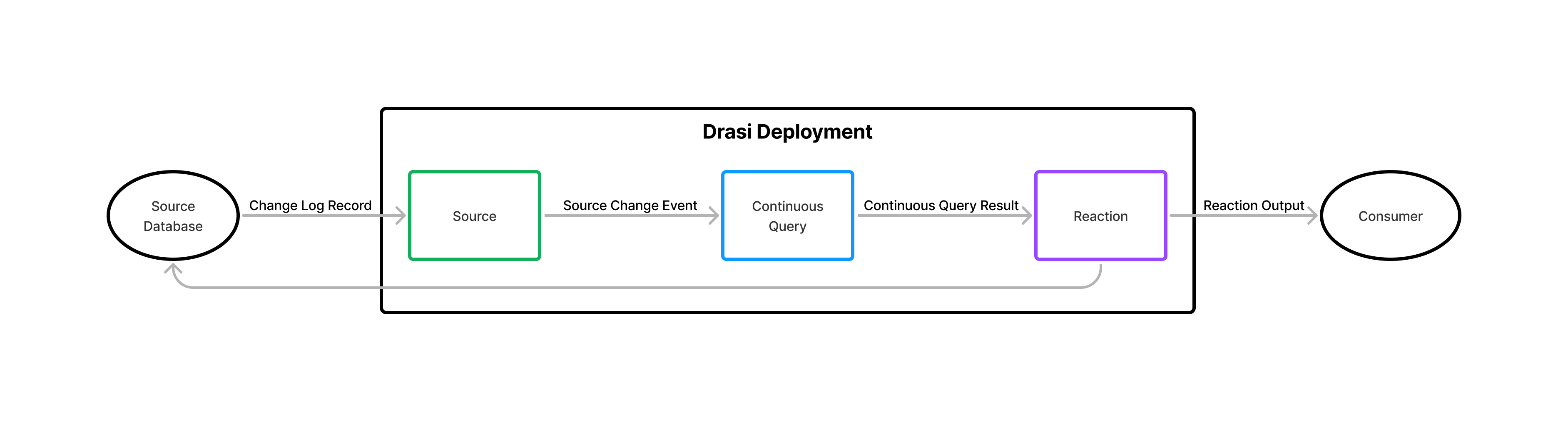
Its architecture is fairly simple:
- Sources to ingest data from existing systems (similar to sources in event processing terminology)
- Continuous Queries that evaluate incoming data from different sources against user-defined, high-level “business conditions”, and emit events when those conditions are satisfied
- Reactions to push events to downstream consumers (similar to sinks in event processing terminology)
It supports simple pipelines with a single source and a single consumer:
Or more complex pipelines with multiple sources and multiple consumers:
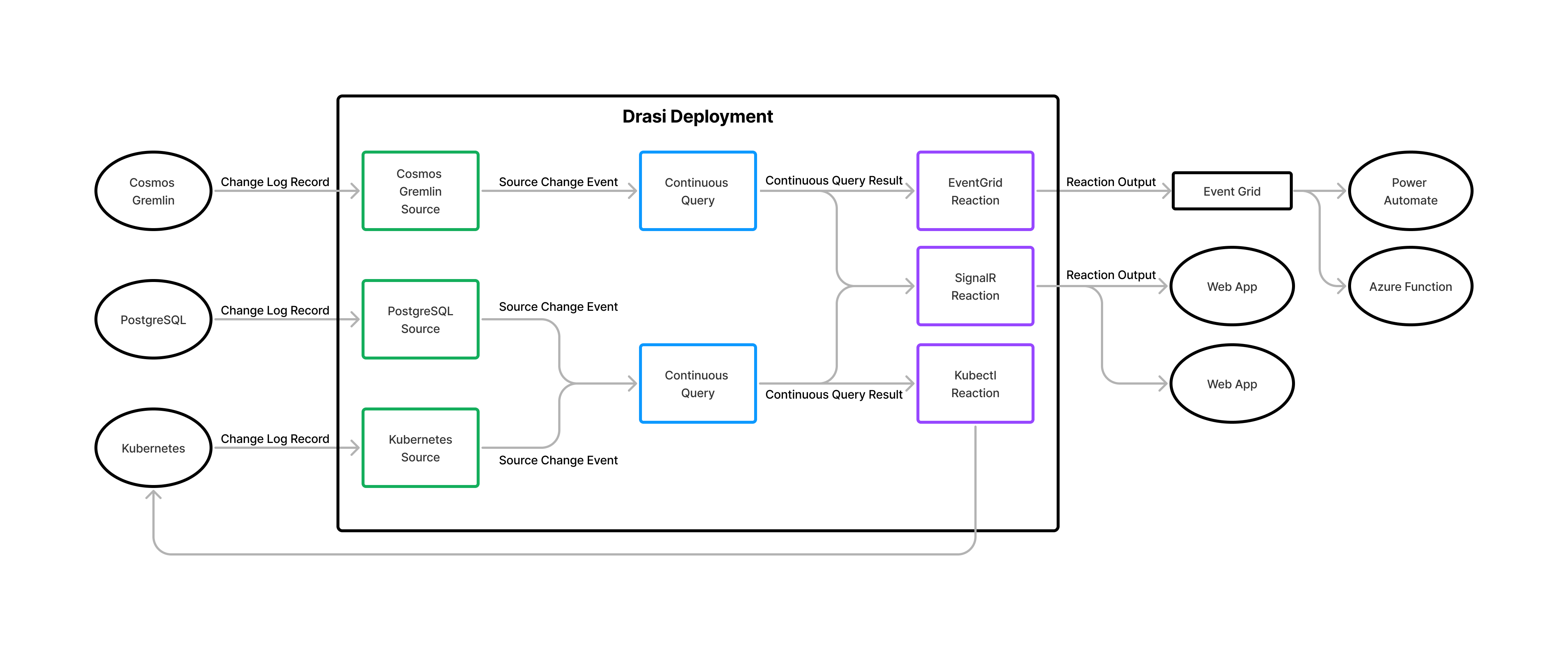
The best part about Drasi is its flexibility; it supports multiple deployment models (as a Rust library for embedded or edge services, as a binary for local development or containerized services, or as Kubernetes deployments with a fully-fledged control plane). Every part of its architecture is pluggable and can be customized to your own needs (you can even contribute new sources and reactions). Queries are not written in an obscure, domain-specific language — Drasi supports industry-standard graph query languages such as Cypher and GQL.
With Drasi and the extension for Dapr Agents, the amount of configuration and application code needed to build an end-to-end change detection pipeline — and have agents to react to those events — is reduced significantly. The Drasi example in the Dapr Agents repository demonstrates this with a minimal amount of configuration and application code, shown below for your convenience:
Source
products.yaml specifies the connection details and the target data sources (which in this case is a products table in a Postgres database):
apiVersion: v1
kind: Source
name: products-source
spec:
  kind: PostgreSQL
  properties:
    host: postgres.default.svc.cluster.local
    port: 5432
    user: postgres
    password: postgres
    database: postgres
    ssl: false
    tables:
      - public.products
Queries
critical-stock-event.yaml specifies a Cypher query to emit an event when a product is out of stock:
apiVersion: v1
kind: ContinuousQuery
name: critical-stock-event-query
spec:
  mode: query
  sources:
    subscriptions:
      - id: products-source
        nodes:
          - sourceLabel: products
  query: >
    MATCH
        (p:products)
    WHERE
        p.stock_on_hand = 0
    RETURN
        p.product_id AS productId,
        p.product_name AS productName,
        p.product_description AS productDescription,
        p.stock_on_hand AS stockOnHand,
        p.low_stock_threshold AS lowStockThreshold
low-stock-event.yaml specifies a Cypher query to emit an event when a product is below some minimum threshold:
apiVersion: v1
kind: ContinuousQuery
name: low-stock-event-query
spec:
  mode: query
  sources:
    subscriptions:
      - id: products-source
        nodes:
          - sourceLabel: products
  query: >
    MATCH
        (p:products)
    WHERE
        p.stock_on_hand <= p.low_stock_threshold AND p.stock_on_hand > 0
    RETURN
        p.product_id AS productId,
        p.product_name AS productName,
        p.product_description AS productDescription,
        p.stock_on_hand AS stockOnHand,
        p.low_stock_threshold AS lowStockThreshold
Reaction
inventory-events-publisher.yaml describes where to route events using Dapr’s pub/sub API
kind: Reaction
apiVersion: v1
name: inventory-events-publisher
spec:
  kind: PostDaprPubSub
  queries:
    low-stock-event-query: >
      {
        "pubsubName": "drasi-pubsub",
        "topicName": "drasi-events-low-stock-event-query",
        "format": "Unpacked",
        "skipControlSignals": true
      }

    critical-stock-event-query: >
      {
        "pubsubName": "drasi-pubsub",
        "topicName": "drasi-events-critical-stock-event-query",
        "format": "Unpacked",
        "skipControlSignals": true
      }
Agent App
The “glue code” in app.py for subscribing an agent to Drasi queries is only a handful of lines
(note: some parameters such as agent instructions and task have been simplified for brevity):
import asyncio
from typing import Any

from dapr_agents import AgentRunner, DurableAgent, DaprChatClient
from dapr_agents.agents.configs import (
    AgentExecutionConfig,
    AgentMemoryConfig,
    AgentPubSubConfig,
    AgentStateConfig,
)
from dapr_agents.agents.schemas import TriggerAction
from dapr_agents.memory import ConversationDaprStateMemory
from dapr_agents.storage.daprstores.stateservice import StateStoreService
from dapr_agents.workflow.utils.core import wait_for_shutdown

from dapr_agents.ext.drasi import DrasiChangeEvent, drasi_trigger


def make_task(event: DrasiChangeEvent, ctx: Any) -> TriggerAction:
    return TriggerAction(
        task=(
            "Create a purchase order with the following data:\n\n"
            + event.payload.after.model_dump_json()
        )
    )


async def main() -> None:
    agent = DurableAgent(
        name="InventoryAgent",
        role="Expert procurement assistant capable of reacting to stock events",
        goal="Create purchase orders for stock based on stock events.",
        instructions="Create purchase orders, calculating the order quantity dynamically.",
        llm=DaprChatClient(component_name="llm-provider"),
        memory=AgentMemoryConfig(
            store=ConversationDaprStateMemory(store_name="agent-memory"),
        ),
        pubsub=AgentPubSubConfig(
            pubsub_name=AGENT_PUBSUB_COMPONENT,
            agent_topic="inventory-agent",
        ),
        state=AgentStateConfig(
            store=StateStoreService(store_name="agent-runtime"),
        ),
        execution=AgentExecutionConfig(max_iterations=1),
    )

    # Register Drasi query subscriptions
    drasi_trigger(
        agent,
        query_id="critical-stock-event-query",
        task_mapper=make_task,
        operations="i",
    )
    drasi_trigger(
        agent,
        query_id="low-stock-event-query",
        task_mapper=make_task,
        operations="i",
    )

    runner = AgentRunner()
    try:
        runner.subscribe(agent)
        await wait_for_shutdown()
    finally:
        runner.shutdown(agent)


if __name__ == "__main__":
    try:
        asyncio.run(main())
    except KeyboardInterrupt:
        pass
You can try out the full example for yourself in the Dapr Agents repository.
Future look: dynamic Drasi query subscriptions and scale-to-zero for Dapr Agents workloads
Currently, Drasi query subscriptions are “static” and embedded in application code, meaning that the agent developer has to know what queries are available and include all potentially necessary queries before the agent app starts. This poses a problem especially in environments where teams own separate services, as agent developers would have to be in constant communication with teams managing Drasi services to know the exact queries that exist at any given point in time. To prevent the need for “ad-hoc API contracts”, the next step for the Drasi extension is to expose Drasi query subscriptions as MCP tools so agents can discover and subscribe to the queries that they need — this also happens to support long-running, autonomous agents as a byproduct.
Returning to the marketplace order issue event mentioned above (“a customer’s order was placed…”), imagine now that the event is part of a larger, marketplace order fulfillment workflow:
- An order service receives a customer order event and initiates a workflow.
- The workflow verifies the order, checks for fraud, completes payment, and then delegates troubleshooting to a separate agent service.
- The agent starts up and immediately suspends, waiting for the delivery to successfully complete. This step can last for several hours, several days, or even several weeks. If Drasi raises an issue event before the delivery is complete, the agent can be reactivated to proactively resolve the issue.
Thanks to Dapr Agents’ durability and actor-based architecture, the agent can safely “go to sleep”, and its in-memory workflow state in the Dapr sidecar can be freed up during that idle time (allowing for “scale-to-zero” agents). However, the agent app itself continues to run and consume resources even if there are no incoming orders (demand may fluctuate), and with multiple instances of an agent app, the amount of wasted compute/resources can add up quickly. To address this, Dapr Agents should support scaling based on metrics such as the number of active, non-suspended workflows and/or the rate of incoming events, enabling not just scale-to-zero agents, but scale-to-zero workloads.
How to get involved
Feedback and contributions are always welcome. Join the Dapr discord, raise an issue in the Dapr Agents repository, or learn how to contribute to the Drasi extension.
To learn more about Drasi, join the Drasi discord, view the documentation, or try out some of the tutorials.